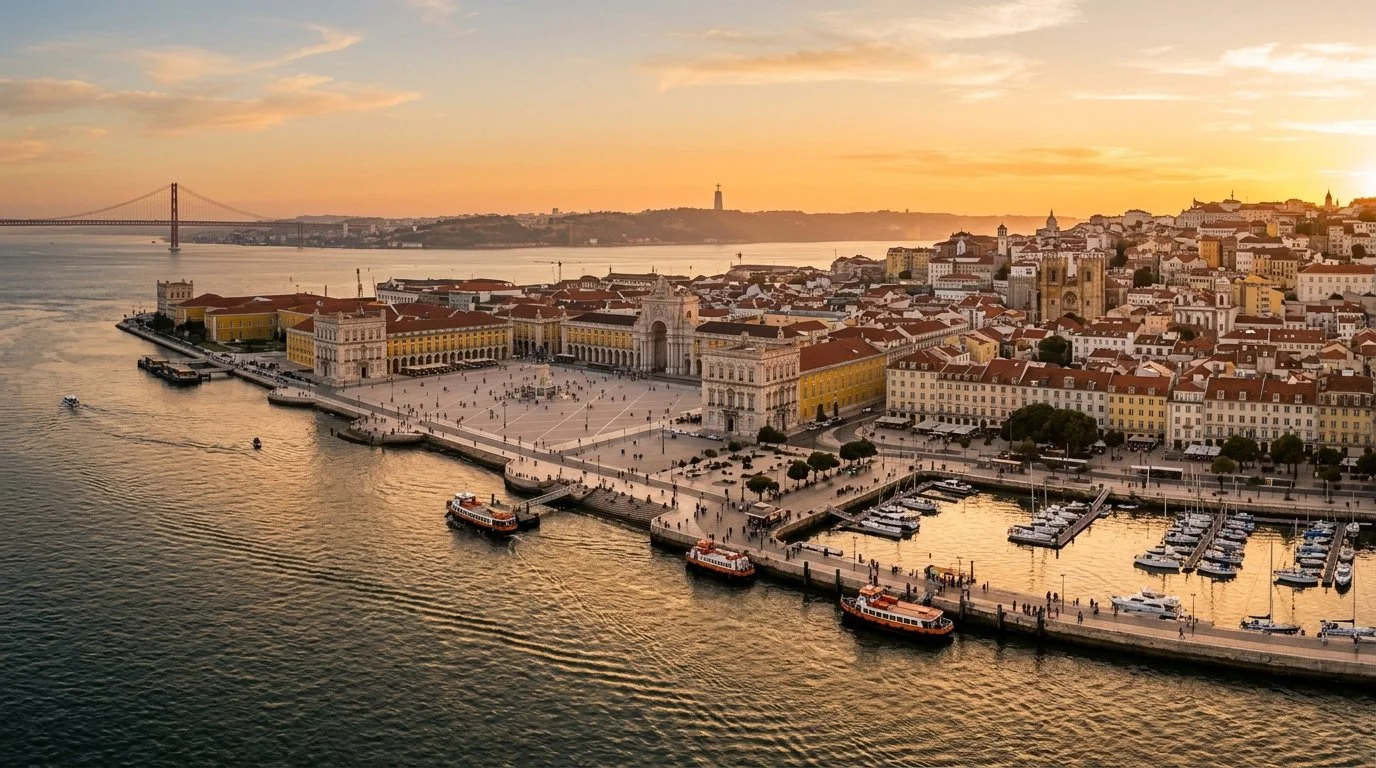
Portugal is often described as a small country, which is true, but we can’t ignore the fact that we possess one of the largest maritime territories in Europe - Portugal has the 5th largest exclusive economic zone (EEZ) within Europe, 3rd largest of the EU and the 20th largest EEZ in the world.
Thanks to the Portuguese Exclusive Economic Zone and the proposed extension of our continental shelf, Portugal has the possibility to command a blue empire that would make several nations blush.
Ironically, while our ancestors once sailed across oceans with enviable confidence, today we struggle to process maritime permits without triggering mild existential crises.
Portugal’s maritime territory spans over 1.7 million square kilometers (with the desire to go for 4 million with the submitted claim to extend its jurisdiction over additional 2.15 million square kilometers of the neighboring continental shelf), a number so vast that it often surprises even Portuguese citizens. We are, in legal terms, a maritime powerhouse.
During the Discoveries, Portuguese sailors navigated uncharted waters guided by stars, instinct, and a remarkable tolerance for danger. Today, maritime navigation requires compliance with international maritime conventions, safety certificates, environmental impact assessments, and enough documentation to sink a medium‑sized vessel.
If Vasco da Gama were alive, he would probably ask: “How many forms do I need to fill out before rounding the Cape of Good Hope?”
And someone at the port authority would reply: “All of them.”
Managing such a vast maritime territory involves complex layers of law. And Portugal’s legal framework is robust, but the administrative machinery often moves at a pace best described as “tidal.” The truth is simple: managing a maritime territory of this scale requires efficiency, coordination, and a willingness to modernize systems that still behave as if the Discoveries ended last Tuesday.
If we were to identify the main challenges and propose solutions, they would include the following:
Excessive legislative fragmentation: consolidate and modernize maritime legislation through a more coherent and integrated legal framework.
Overlapping administrative competences: clarify institutional responsibilities.
Slow and bureaucratic licensing procedures: streamline administrative processes, increase digitalization, and establish clear decision-making timelines.
Difficulties in maritime spatial planning: improve integrated planning mechanisms to balance competing uses of maritime space.
Conflict between economic development and environmental protection: promote a sustainable blue economy that reconciles investment and growth with marine conservation objectives.
Regulation insufficiently adapted to emerging activities: develop regulatory frameworks capable of addressing new sectors such as offshore renewable energy, marine biotechnology, and autonomous maritime technologies.
Challenges in monitoring and enforcing regulations across a vast maritime area: invest in technological capabilities, surveillance systems, and inter-agency cooperation.
Outdated maritime legal regimes: modernize maritime laws and align them with current international standards and industry practices.
These issues have been debated ever since I was in school, yet little appears to have changed.
Portugal’s identity is inseparable from the ocean. Our literature, our history, our cuisine, our economy — everything flows from the sea. Yet our legal and administrative systems often treat maritime matters as if they were exotic inconveniences rather than national pillars.
We are a maritime nation that sometimes forgets we are one.
After all, we are the country that once mapped half the world with caravels, but today struggles to map a maritime permit without three committees, two delays, and one prophetic anonymous online commentator claiming his approval arrived in “just two weeks”.