
Easement Limitations: Land Court Rejects Emergency-Access Workaround
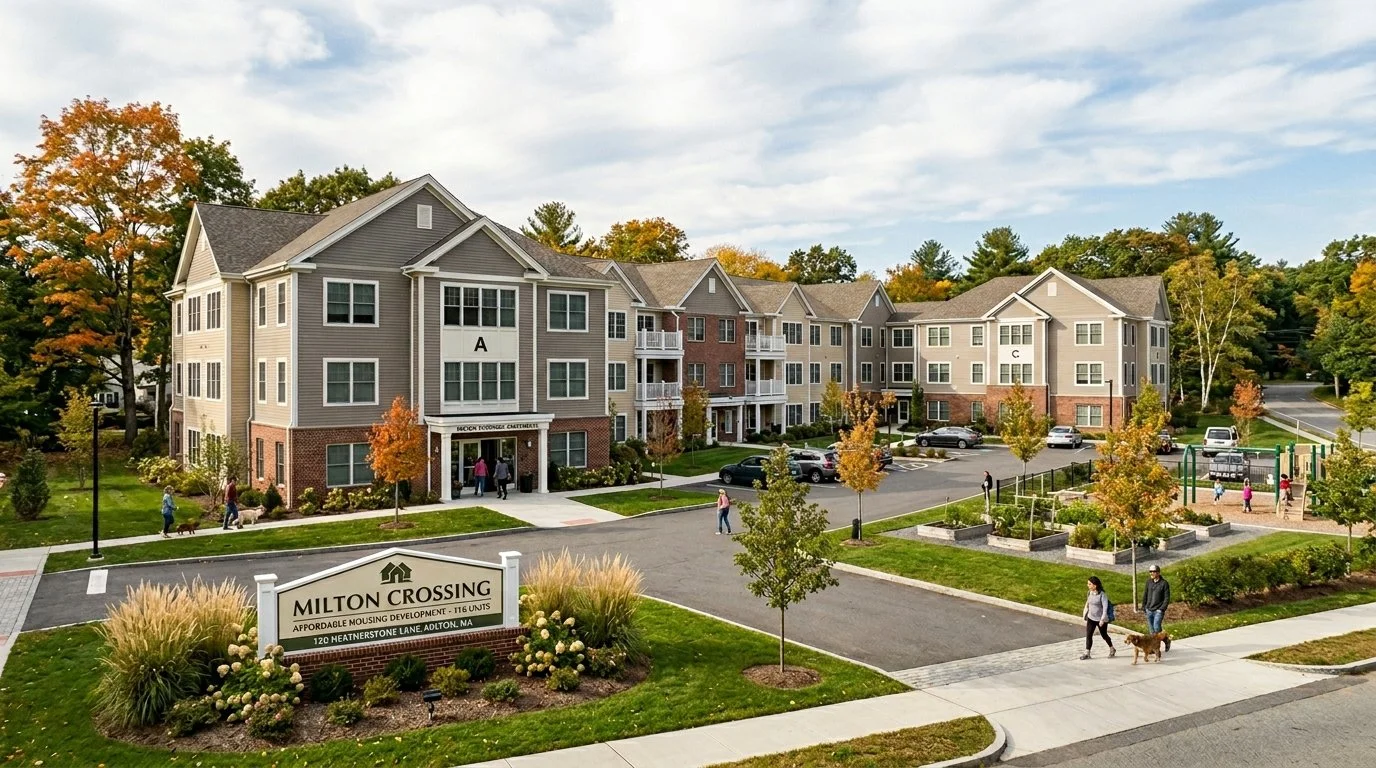
Farkes v. 648 Canton Avenue, LLC involved a dispute arising from the approval of a comprehensive permit under G.L. c. 40B to construct a 116-unit affordable housing development in Milton, Massachusetts (the “Project”). The plaintiffs, who are abutters to the Project site, challenged the development on multiple grounds, including that the proposed use of a private road, Merjwood Road, for secondary emergency access would unlawfully overburden an existing easement.
The plaintiffs initially filed suit in Superior Court, asserting claims under G.L. c. 40A, § 17, G.L. c. 214, § 7A, and for declaratory relief concerning the scope of the easement. The case was later transferred to the Land Court’s Permit Session, where the court dismissed the zoning and environmental claims, leaving only the easement issue for resolution on cross-motions for summary judgment.
The Project spanned two adjacent parcels: 648 Canton Avenue and 652 Canton Avenue. While the 652 parcel benefitted from an express easement over Merjwood Road, the 648 parcel did not. The comprehensive permit required the developer to construct a secondary access road over the 652 parcel via Merjwood Road, which would be used exclusively by emergency vehicles but would serve the entire Project – including the 648 parcel.
The central issue before the Court was whether this proposed use would constitute an impermissible overloading of the easement. Relying on longstanding Massachusetts precedent, the Court applied a “bright-line” rule: an easement appurtenant to a particular parcel cannot be used to benefit other land, even if the additional use does not materially increase the burden on the servient estate.
The developer argued that the limited, emergency-only nature of the access should not be considered an overburdening. The Court rejected this argument, emphasizing that the bright-line rule avoids precisely such fact-intensive inquiries into the frequency or impact of use. The developer also contended that emergency responders’ statutory rights to access private property should permit the use, but the court found that argument unpersuasive and unsupported by the statutory framework.
Applying the bright-line rule, the Court concluded that the proposed emergency access would benefit the entire Project, including the parcel without easement rights, and therefore constituted an impermissible overloading as a matter of law. The Court granted summary judgment in favor of the plaintiffs and denied the developer’s cross-motion.
Farkes reinforces that Massachusetts courts will strictly apply easement limitations, even in the context of affordable housing developments, and will not permit creative workarounds that extend easement rights beyond their intended scope.